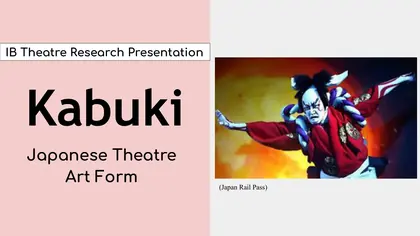
IB DP Theatre
Research Presentation
Fifteen filmed minutes on an unfamiliar tradition and one performance convention. No written report. The camera is the examiner.
The 15 minutes, section by section
There are no written reports for this component: it is a 15 minute video, broken down into roughly equal sections, criterion by criterion. Criterion A in particular needs verbal citations. The example running through this page is one student's work on Kabuki and the mie. You are not expected to choose Kabuki: use it to see what each section is asking of you.
Every quote on this page is transcribed from a real student presentation on Kabuki and the mie. Your tradition and convention will be different: read them for what each section is doing, not for the content.
What will stop you getting a 7
Miss one of these and your mark is capped before the examiner gets to your content.
- 1
Tradition not on the prescribed list → max 13/24 total
Choose from: Kabuki · Kathakali · Noh · Kyōgen · Peking Opera · Cantonese Opera · Yueju Opera · Barong · Kecak · Topeng · Wayang Golek · Wayang Kulit · Khon · Hun Lakhon Lek · Talchum · Rakugo · Jatra · Nautanki · Commedia dell'arte · Elizabethan · 17th C French farce · British Pantomime · Punch and Judy · Karagöz · Victorian Melodrama · Pastorela.
- 2
Production convention chosen instead of performance convention → flagged
PERFORMANCE = body/voice (mie, mudras, lazzi, suriashi, dame physicality). PRODUCTION = anything else (set, lighting, costume, sound). Pick performance.
- 3
No sources cited in the presentation itself, max 1 mark each for Ai and Aii
References must appear in speech, on slides or in your visual support. A bibliography on its own does not count. Cite throughout: the more you reference your research as you speak, the stronger Criterion A gets.
- 4
Bii without LIVE physical demonstration → 0 marks
Video of past work is not enough. You must physically demonstrate live, on camera, in the formal setting, and you must demonstrate as you talk rather than performing straight through.
- 5
15 minutes is the maximum limit
Examiners stop watching at 15:00 and anything after that is unmarked. A common split is A around 6 minutes, B around 6 minutes, C around 3 minutes.
Explain the unfamiliar theatre tradition
EXPLAIN, not describe. Personal engagement, and connections between elements (how set and sound work together, how costume and make up work together).
- Open with geography + period + cultural function in two sentences. Not "Kabuki is a Japanese theatre tradition that…"
- Pick 2–3 elements to go deep on, depth over survey. A tour of every element ceilings at 5–6.
- For each element, ask "WHY does it look this way?" and explain the reason behind it.
- Make a connection between two elements and explain how they work together.
- Cite 2+ sources verbally or on slide. Name the author as you speak.
My chosen world theatre tradition which I will be presenting today is Kabuki, a Japanese theatre art form that originated in 17th century Kyoto. According to Britannica, "ka" signifies song, "bu" means dance and "ki" means skill, already showing us how music, choreography and a high level of proficiency in the art form are integral.
This dance found itself becoming an inspiration which diffused into a multitude of local troupes, and consequently Kabuki became Japan's first dramatic art form that catered to commoners, which shows why the art form was incredibly prevalent, important and popular in the society at the time.
Sound and voice are also very important, and according to the book Music and World Cultures by the University of Arkansas, tsuke is the sound effect created by hitting two pieces of wood on the side of the stage against a board. This really helps to accentuate the movements of the actor and heighten the intensity of emotions presented by the characters, especially during a mie.
According to Laurence Kominz from the Asian Theatre Journal this was the tourist gate… and thus it was banned in 1629, leading to the emergence of wakashu kabuki which was performed by young boys. However in 1652 this was banned again due to similar motivations from the performers, and according to UNESCO, as a result of these changes Kabuki is now performed solely by men.
Explain the performance convention
Isolate ONE performance convention (mie · mudras · lazzi · suriashi · dame). Explain how, why, when. Focused depth, not repeated tradition info.
- Name one convention. Multiple → examiner only marks the most explained one.
- Explain development, how, why, and when the convention emerged.
- Describe what it physically looks/sounds like; if camera permits, brief demo (a held mie, one mudra). Save trial and error for Bi.
- Explain when in a performance it appears and its dramatic function.
- Show personal engagement, what struck, surprised, or counter intuitively challenged you.
Now moving on to my Aii. The chosen performance convention which I will be exploring today is the art of the mie, which according to Invitation to Kabuki means, literally translated, "pose".
According to the Japan Arts Council the mie was created by Ichikawa Danjūrō, who originated the aragoto style when he imitated Fudō Myōō, a lord of light, in a threatening pose in an attempt to highlight his strength. According to the ARC, in Buddhism he is known as the immovable or unshakable one, again really emphasising the true purpose of the mie in depicting strength.
According to the video How to Perfectly Execute a Mie, the actor must first spread their legs apart, keep their body low to the ground and position their limbs in a way that is most visible to the audience while keeping their back straight. This low and upright posture is used to amplify the character's large, powerful and dominant nature as it depicts strength.
According to Leonard C. Pronko from the Johns Hopkins University Press, the mie, which is a pose of dynamic and fluid tension, is presented at the climax of any scene in order to create a closer connection between the character and the audience. This was originally reserved for moments of violence, tension or passion. However its usage gradually expanded to any moment of climax, reflecting its popularity amongst audiences.
Practical exploration, show stages of growth, not a sequence of exercises
Demonstrate (live or media) the process of learning the convention. Named stages of growth, breakthrough moments, response to specific feedback.
- Open with a before state: what you could and couldn't do at the start. Be honest about the limit.
- Show 2–3 named stages with timestamped clips. Not "lots of practice", stages with names ("Stage 1: stance" etc.).
- Name a breakthrough moment, what clicked, what made it click.
- Quote specific feedback from a peer/teacher and show how you acted on it.
- Close with a live physical demonstration on camera proving the growth.
I divided my exploration into the three fundamental principles of the mie: posture, movement and face. And I chose to explore this by watching videos on the YouTube channel Kabuki In Depth.
These footsteps are meant to be heavy to portray the grandioseness of the character, but after reviewing my practice videos I realised that my footsteps were actually quite gentle, which goes against the purpose of the aragoto. So to fix this I then started to consciously place more emphasis and body weight in each step.
Then I looked at head movement. The videos I watched had the character at the end of the mie whip their heads in a quick motion. At first attempting this made me quite dizzy and disoriented, but to help me with this I again made sure to spot the same point on the adjacent wall, as it provided me a fixed focus which helped to decrease the dizziness.
So I began with the exploration of posture. I went into a deep squat with my legs widened, holding my head up and tension throughout my upper body. When I showed this to my mentor I was informed that I had a tendency to slump my shoulders, so I found it really helpful to round back my shoulders when attempting the pose to make sure my chest was facing outwards.
Similarly, as you can see in this image, I had my mentor gently push me over to make sure I was holding tension in the right parts of my body. Through this I realised that I needed to hold more tension in my legs as I was easily falling over. The end goal with this exercise was for my mentor to feel like they were pushing a wall, in alignment with the unyielding willpower and arrogance of the aragoto.
Experimentation, the language of "I tried this, but…"
Apply the convention to traditional material from the tradition (not adapted). The language of trial and adjustment. You must demonstrate physically as you talk: the examiners do not want a straight performance, they want you showing and explaining at the same time.
- Name traditional material precisely, title, source, why it qualifies. No Hamlet in Noh, no modern adaptations. Caps Bii at 1.
- Show your first attempt live as you talk, narrating what did not work.
- Show the adjustment live as you explain what changed and why, tied to the logic of the convention.
- Cover 2+ trial and adjustment cycles. One reads as luck; two reads as method.
- Close with the final live demonstration and one sentence on what the experimentation taught you. Keep demonstrating as you speak rather than delivering a straight performance.
My chosen Kabuki text is titled The Wicked Priest and the Seductive Princess. This is known to be one of the oldest Kabuki plays, first performed by Ichikawa Danjūrō in 1684. The aragoto character in this play is the priest Narukami… he becomes transformed by rage, declaring he will become the Thunder God, and consequently performs the hashiramaki no mie.
When watching the video on Kabuki In Depth I noticed that when the actor was moving into the scene it was, yes, heavy, but more specifically they were moving from heel to toe, which was different to what I was doing, which was just stomping on a flat foot. Thus to improve this I started to consciously walk first placing my heel down and then rolling to my toe.
Through experimenting with this I realised that I found difficulty with the balance and holding the pose for long periods of time, as I was shaking and falling over. So to help with this balance I found it helpful to lower my one legged squat and engage my core even more.
I also experimented with placing my hand on different parts of the stick. At first I noticed I was placing my hand too high up on the stick, which impaired my balance as it was making me wobble as I had no control over the stick and it was slipping. However when I placed my hand around head level it became instantly a lot easier for me to control the stick, and made it easier to balance.
In my Aii we know this is a mie that is wrapped around a pillar, but since I do not have access to a pillar, as evidenced in my Aii I will be using a bamboo stick, as it is a form of Japanese weaponry.
Reflect on your continuing development as a performer
How this exploration changed you, with specific reference to the convention. Concrete before/after, not "I learned a lot."
- Name a specific skill or attitude you held before, concrete.
- Name what shifted, tied to the specific convention.
- Connect to a prior performance experience, show the new skill applying.
- Be specific about what kind of performer you're becoming. Not "more confident", name the change.
Through my exploration of Kabuki I have realised that this highly stylised physical nature presented me with quite a challenge, as I was more inclined to naturalism.
Furthermore, through my research I now understand the importance of moments of stillness within the play to enhance audience engagement. When reflecting on the purpose and effect of the mie I have grasped how these moments give the audience time to think, to reflect and to take in everything that is happening at once.
In a previous production I did, like The Tempest where I played Prospero, reflecting back on the scene where Prospero was outraged by Caliban's plot on his life, I realised that my over reliance on dialogue in conveying emotions and tension within the scene meant I primarily focused on my tonal variation, volume and pace, dismissing the body's role in conveying these important messages.
Last year I directed and acted in my own devised play, where each scene flowed directly into the next, being very naturalistic in style, with continuous action without there being at all a pause. However, now having realised the importance of moments of stillness in theatre, through my exploration of the mie I would now place deliberate pauses and breaks in the action where my character or the other characters freeze in moments where their physicality portrays the emotions they are currently feeling.
Reflect on your understanding of theatre in the world
Beyond comparison. Unique perspectives from your research, community, transmission, spirituality, aesthetics. Platitudes ceiling at 5–6.
- Start with a concrete observation from your research that surprised you.
- Identify a broader concept the insight points to. Don't reach for "all theatre is human expression."
- Compare to one other tradition, to push to a deeper question, not declare one better.
- Close with what the research changed in how you watch other theatre now.
Through my inquiry I have learned that as a theatre tradition it is heavily rooted and grounded in the spiritual, cultural and ritualistic aspects of Japanese society. For example, in Aii I discussed how the aragoto mie was inspired by Fudō Myōō, a strong Buddhist deity. So evidently in Kabuki there are clear connections between religion and the use of the body.
Through my Kabuki exploration, especially my inquiry into the mie, I started to recognise the importance of universality in theatre. In the world we are a large, vibrant mix of cultures and backgrounds, and thus language should not serve as a sole conduit for meaning. When watching Kabuki plays in my inquiry I understood the meanings and emotions coming across without having a grasp on the language.
Whereas Western theatre practices are more heavily rooted in the fundamentals of human nature, the human psyche and politics, having more of a social and political foundation, like inner monologue or Brecht's alienation effect.
I have started to draw parallels between modern physical theatre groups and this Eastern theatre tradition, like Gecko and Frantic Assembly, who are breaking boundaries through movement and physicality to convey their Western political messages. Companies like The Paper Birds for example are starting to borrow these Eastern styles and blending them with Western motifs.
How it is actually marked
Drawn from the IB’s own examiner guidance for the Research Presentation (May and November 2024 sessions). These are the rules the person marking your video has been told to apply.
Cite your research as you speak
No references to research at all, or references only in the bibliography, caps both Ai and Aii at 1 mark. References count when they appear in your speech, on your slides or in your visual support. Do not stop at one: the more consistently you cite your research as you explain, the stronger Criterion A gets. Name the author as you speak.
The examiner listens for “this tells me that…”
Explanation means the why behind a feature, real personal engagement (“I think that”, “I can deduce from this”) or connections between elements, like how set and sound work together. A longer description is still a description.
15 minutes is the maximum limit
Examiners stop the recording at exactly 15 minutes and cannot mark past it. They are also told that more time on a section does not mean a better answer: a focused 2 minutes can outscore a rambling 3.
Choose one convention and hold it
If you present more than one, the examiner credits only one of them. Keep Aii focused on explaining your chosen convention.
The material must belong to the tradition
Adaptations, or material merely performed in the tradition, cap Bii at 1 mark. A Noh performance of Hamlet does not count. Material written later but clearly for the tradition’s conventions, like a modern pantomime, is accepted. No material named at all scores 0.
Bi wants a process, not a list of exercises
To reach the higher bands, show clear stages of growth: how the process developed, key moments, specific feedback from peer mentors and how you responded. Pictures or clips alone are not enough without the explanation that goes with them.
“I tried this, but…” is the highest leverage phrase
This is how examiners are told to place Bii, the most precisely marked strand of the whole component.
The deck behind a real presentation
The presentation itself is a 15 minute film, so it cannot live here. The slides the student built and presented from can. Read them alongside the sections above.